Altair Proudly Supports Student Teams

Terms of Use | Privacy Notice | Data Privacy Framework | Cookie Notice | DMCA | Whistleblowing |
© Altair Engineering Inc. All Rights Reserved.


Altair® Inspire™’s powerful and user-friendly tools help you enhance your aircraft’s performance with advanced structural simulation, lightweight optimization trusted by top teams to achieve winning results.

Altair® Inspire Motion® lets you quickly run dynamic analyses on your aircraft’s moving systems. You can easily define joints, contacts, and inputs to simulate motion, validate system performance, and connect results with structural and optimization simulations.

Altair® HyperMesh® and OptiStruct® enable teams to efficiently design and optimize composite vehicle and aero structures by providing advanced stress analysis and automated development of tailored composite layups.

Altair® FlightStream® software streamlines aerodynamics analysis with an easy-to-use interface and advanced solver, helping vehicle designers quickly reduce drag and improve performance.
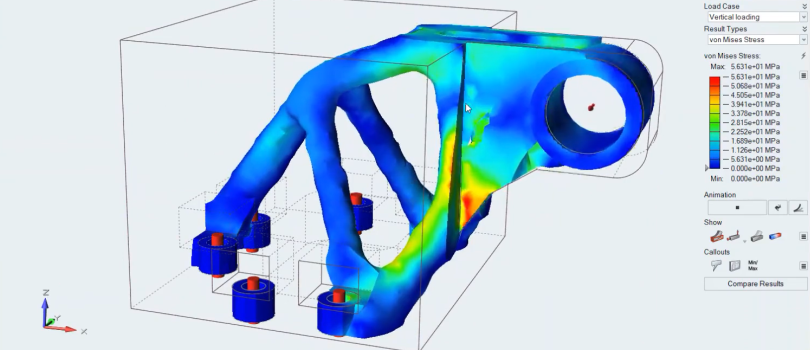
In conjunction with its industry-leading solvers, Inspire's intuitive interface can get you results in a fraction of the time of other leading analysis tools. From checking to determine how much a part deforms, to making sure a critical bracket can take the necessary loads without breaking, to even checking vibrational frequencies, Inspire is the ideal structural analysis tool to help you design your vehicle to go the distance.

Inspire leverages the powerful optimization capabilities of OptiStruct, the pioneer tool of Topological Optimization in engineering. In a competition where weight is critical, Inspire ensures your vehicle is lightweight without compromising strength or safety. It supports various manufacturing methods like milling, casting, cutting, and 3D printing. Design a faster, more efficient vehicle with Inspire.

A complex aircraft has numerous intricate moving parts. Ensure they operate correctly using Inspire's motion simulation tools, which include automatic joint creation, simple motor and actuator setup, and rapid contact generation. After your analysis, you can easily extract joint and contact forces and integrate them into structural analysis and optimizations for dynamic loading.

Watch the video above for a detailed exploration into preparing composites models in HyperMesh and analyzing it in OptiStruct. HyperMesh’s intuitive, process-driven composite modeling capabilities make setting up your composite analysis a breeze, and OptiStruct’s advanced composite engine will give you the analytical and optimization results to bring your aircraft to the next level.
Also, please take a look at the links below for step-by-step tutorials for the use of HyperMesh and OptiStruct for composite analysis and optimization.

The video above is an in-depth exploration of utilizing HyperMesh’s extensive preprocessing capabilities to prepare models for aerodynamic analysis in FlightStream. The video outlines the processes followed to get your model ready for FlightStream and explores advanced functionalities to make sure your FlightStream results are the best and most useful that they can be.

Watch the video above to see the capabilities of FlightStream and help you envision how this powerful tool can assist you in creating better airframes that can help you excel in your aero competitions.
In the links below, you can find our entire FlightStream class, which is an extensive exploration into and training on all the functionality of FlightStream to enable you to get to work utilizing this useful tool. Additionally, the YouTube playlist will provide you with an easy, guided path to learning FlightStream in preparation for utilizing the software to rapidly create aerodynamic studies of your vehicle.

Learn how Altair Inspire helps student teams use simulation-driven design to accelerate innovation, optimize structures, and improve performance. This workshop demonstrates how integrating simulation early reduces development time, lowers material costs, and provides valuable engineering insights for projects like race cars, robots, and complex assemblies.

Aerodynamic design is vital in student competitions supported by Altair. Traditional CFD tools slow down the process due to complex setups and long run times. Altair Flightstream is a modern panel method solver that simplifies model building, is easy to use, and delivers high accuracy much faster than standard methods. This presentation shows how Flightstream can be applied throughout the aerodynamic design process, from early concepts to detailed development.

Learn how the easy-to-use Inspire Motion functionality can quickly get you on your way to simulate dynamic systems in your aviation model. This session will highlight how to set up a motion analysis on a real-world aircraft landing system (Airbus A380) to test how the kinematic system performs, evaluate loads, validate actuator capability, and even prepare the model to couple motion with analysis to perform structural tests on your designs. This session is your first step to high-value motion analyses on your designs for competition.
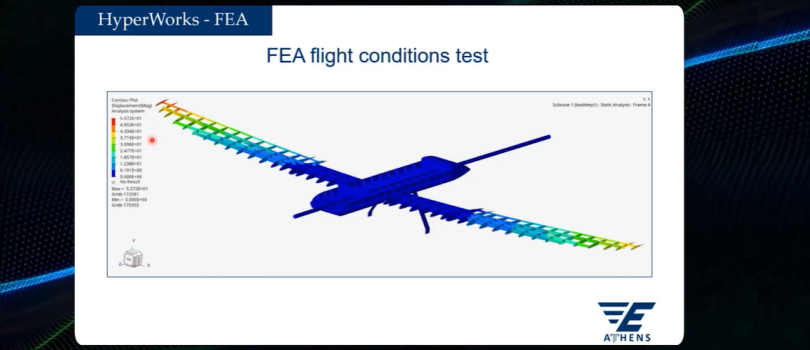
The EUROAVIA Athens team used Altair tools in the design process of their two RC Planes, which participate in International Competitions. Their latest aircraft, HERMES VII, already won 3rd place in the New Flying Competition in Stuttgart, Germany, in the 2025 summer, and the team is looking forward to competing and winning many more competitions going forward.

This project attempts to build an accurate real-time (RT) drone simulator through the full integration of a 1D functional model of a drone created in Altair Activate®, along with its corresponding geometry, into Unreal Engine via the Functional Mock-up Interface (FMI) standard. Then, VR, peripheral controllers, and other functionalities were added to the representation. This task was accomplished by modifying the Altair RT Vehicle Package, making it able to handle not just vehicles, but any system model located in an FMU for co-simulation, in this case, a quadcopter model.


A university team at MIT, Pune used topology optimization and additive manufacturing to develop two new designs for a Quad-rotor UAV drone. This project challenged the students to design, fabricate, and test a quad-rotor UAV using topology optimization to reduce weight while increasing structural strength. By optimizing the design in solidThinking Inspire and 3D printing two new airframes, the team achieved stable flight performance, reduced design time and part count from six to one, and realized an average weight reduction of 32% compared to the original model.
