
Shaping the Future of Semiconductor Design
Faster design iteration, more comprehensive analysis, maximum efficiency compute and simulation license resource use.
Discover how Altair's exceptional solutions are revolutionizing semiconductor design.
The semiconductor design industry is in a state of perpetual evolution, driven by the need for faster time-to-market, stringent industry standards, and advancing technology. This dynamic landscape demands solutions that not only address current challenges but also pave the way for future achievements.
Discover how Altair’s innovative solutions are adeptly tackling every obstacle faced by chip designers, from the management of high-throughput computing environments, expensive EDA license pools and simulation flow management to intricate electromagnetic simulations and 3DIC and chiplet thermal management.
Book a meeting with our technical experts.
Book nowMeet Altair® HPCWorks™ for Semiconductor Design
Enhance the design exploration and verification process with Altair's sophisticated enterprise computing solutions for semiconductor design. Engineering teams trust Altair to outpace competitors and bring their designs to market efficiently, leveraging our innovative and computationally advanced solution set.
To stay ahead in the competitive landscape, your environment must optimize resources and operate with unparalleled speed. Rely on the industry's premier job scheduler to address the intricate requirements of semiconductor design with unmatched scalability, adaptability, and efficiency.
The complexity of chip design is advancing rapidly, necessitating sophisticated visualization tools to keep pace. Flow visualization tools equipped with robust analysis and troubleshooting capabilities are essential for optimizing computational resources, ensuring a more efficient and effective design process at every stage.
Licenses represent a significant investment and are frequently sought after by chip designers within any team. By managing these resources with precision, teams can accelerate their time-to-market and enhance their return on investment. Optimize license utilization by monitoring their usage and facilitating sharing, thereby boosting efficiency and gaining real-time insights.
I/O profiling empowers organizations to identify the most suitable computing environment for various ESD applications and resources. By monitoring applications, organizations gain enhanced visibility, facilitating informed planning. Additionally, application profiling swiftly addresses deployment challenges, ensuring seamless operations.
Hardware emulators represent a significant investment in the chip design process. To optimize this investment, it is crucial to manage every facet of the emulation flow, from design compilation and emulator selection to software and regression testing, using a job scheduler specifically crafted for hardware emulators.
Additional Resources
Guide to Electronic System Development
As performance demands continually increase, packaging sizes become smaller, and device connectivity becomes more critical, schematic engineers and product designers need ways to make efficient design decisions and collaborate with one another to optimize complex interconnected mechanical and electromagnetic systems.
Read more
Leveraging Accelerator Scheduling for Emulation
Altair® Hero™ 2.0 is a queuing solution for specialized compute resources, notably emulators, FPGAs, and GPUs. It provides an abstract definition of hardware resources and allows multiple jobs and multiple resources to share a common queue.
Check it out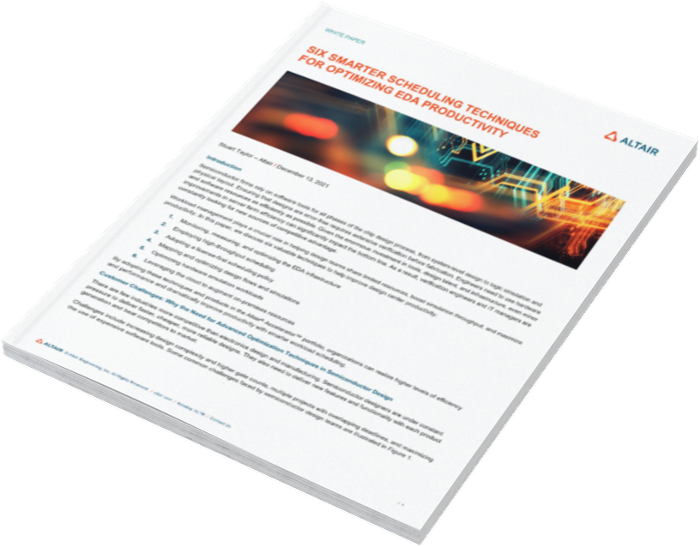
Six Smarter Scheduling Techniques for Optimizing EDA Productivity
Verification engineers and IT managers are constantly looking for new sources of competitive advantage. In this paper, we discuss six valuable techniques to help improve design center productivity.
Check it outComplete Electronic System Design Solution
Altair’s simulation-driven design tools enable your team of skilled engineers to collaborate effortlessly on every aspect of electronic system design. Our solutions refine your workflow, reduce design iterations, and expedite your time-to-market.
Altair® DSim™ is an all-encompassing digital simulator crafted for the precise verification of semiconductor electronics. With support for both SystemVerilog and VHDL, it is perfectly tailored for application-specific integrated circuits (ASICs) and field-programmable gate arrays (FPGAs), providing a sophisticated solution for complex design requirements.
Accessible both on-premises and via our innovative simulation-as-a-service (SaaS) model, DSim democratizes functional simulation for intricate semiconductors, facilitating effortless transitions from desktop to cloud. Discover the strength of concurrent, scalable simulations and adaptable licensing, significantly reducing both time and expenses compared to conventional design approaches.
Mitigating the elevated design and manufacturing expenses linked to growing chip complexity is achievable through sophisticated design and debugging tools that effectively streamline processes and reduce design iterations.
Reliable and proven solutions should deliver swift visualization capabilities to identify cause-and-effect patterns and offer expedited debugging solutions for diverse system-on-chip designs.
These varied designs may encompass analog components, third-party Intellectual Property (IP), multi-core processors, and chiplet-based architectures, all necessitating a flexible analysis and debugging solution for swift design assessment.
Debugging tools empower engineers to refine designs, facilitating earlier production with enhanced assurance and reliability.
Creating electronic products that endure the structural, operational, and environmental demands of everyday use or misuse necessitates sophisticated design solutions. These solutions must minimize prototyping while judiciously balancing time and cost. Altair's innovative automated end-to-end ESD workflows empower multiphysics simulations that account for thermal, vibration, noise, and structural impacts at the chip, PCB, and system levels. By providing access to ESD simulation tools within a unified, collaborative development platform, tailored for both designers and engineering experts, teams can efficiently accelerate development cycles and deliver robust, trustworthy products.
Power converters are integral to nearly all modern electronics, ranging from compact cell phone chargers to expansive multi-megawatt propulsion systems. As the demand for enhanced performance intensifies, circuit simulation assumes a pivotal role in the schematic capture phase of EDA workflows, essential for crafting competitive designs. By embracing industry-validated solutions like PSIM for simulating power electronic systems, companies can effectively optimize energy efficiency and thermal management performance. This approach allows for a comprehensive evaluation of component interactions and overall system responses under varying operating conditions and environmental factors. Furthermore, with streamlined power electronic simulation workflows, companies are empowered to swiftly explore new architectures, materials, and control strategies for complex systems, propelling their next wave of innovations.
Efficient modeling and visualization of electrical circuit systems are crucial for obtaining swift insights into circuit design and preventing expensive design mistakes. Altair HyperSpice, equipped with access to Spice libraries for rapid AC, DC, and Transient simulations, is seamlessly integrated into a versatile system-wide simulation solution, empowering companies to innovate with greater speed and confidence.
Explore Further
Effective Techniques for Managing High Cost Software Licenses
Learn common techniques to reduce waste and more accurately target spend.
Watch Webinar
End-to-end Electronic System Design Toolset
From concept to manufacturing, our products streamline your process, eliminate design iterations, and reduce time-to-market.
Watch Video
The 7 Pillars of Electronic System Design
Discover the are seven key building blocks that make up the electronic system design process.
Read Now