Quick Facts: Requirements and Prizes
Terms of Use | Privacy Notice | Data Privacy Framework | Cookie Notice | DMCA | Whistleblowing |
© Altair Engineering Inc. All Rights Reserved.
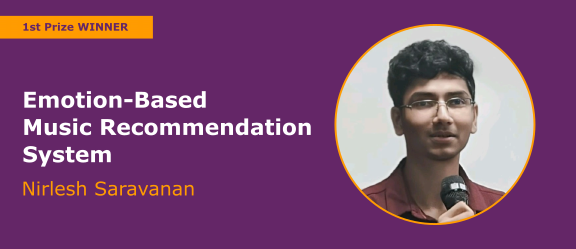
Nirlesh Saravanan, from Sri Sairam Engineering College, delivers a compelling first-prize project that seamlessly connects human emotion with artificial intelligence through music.
Built entirely in Altair AI Studio, his emotion-based music recommendation system combines facial-expression analysis and deep learning to create a personalized, mood-aware listening experience. Using DeepFace to detect emotions such as happiness, sadness, or neutrality, the system interprets real-time facial cues with high accuracy. A second deep learning model analyzes detailed audio features from thousands of songs to classify music by emotional tone and recommend a matching Spotify track.
By integrating computer vision, audio analytics, and intelligent workflow design, this project demonstrates how AI can translate human signals into adaptive, emotionally responsive digital experiences in real time.
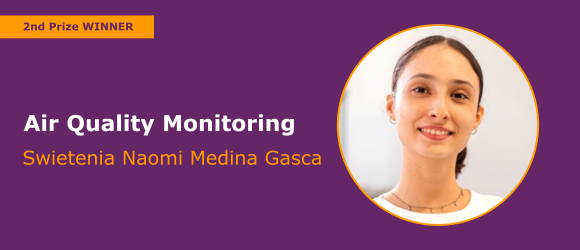
Swietenia Naomi Medina Gasca from Anáhuac Cancún University takes a thoughtful, data-driven approach to air-quality monitoring by examining not pollution itself, but the strategy behind how monitoring networks are designed.
She chose to work in the 3rd contest category, in which she used the Altair-provided dataset but came up with her own problem statement. Using Altair AI Studio, she transformed the complex, unstructured data into a clean analytical workflow, built a predictive model, and visualized key patterns to reveal how station placement, pollutant focus, altitude, landform, and urban context shape monitoring coverage.
Her work demonstrates how AI can validate existing monitoring strategies and inform smarter, more effective network expansion—highlighting the power of data science to support environmental decision-making beyond simple measurement.
Annemarie Kautz from TU Munich, working with an international student team from Tongji University, demonstrates how AI can dramatically accelerate electric aircraft design.
Using simplified eVTOL models, simulation data, and AI-expanded datasets, the team explored how design decisions impact flight time, sustainability, and material use—revealing clear performance–sustainability trade-offs. With an A/B/C rating system and classification models built in Altair AI Studio, they created a faster, more transparent design workflow, including lifecycle tracking through a battery passport.
The project was inspired by Professor Juergen Grotepass, whose long-standing commitment to international, high-impact engineering education continues to motivate students to fuse speed, quality, and sustainable innovation in aerospace design.
Sarah Dambach, Honor Henry, Seth Green, Gavin Cooper, Fairfield University - USA
Coffee quality is often judged by tradition and taste, but this team brought data to the table. Using Altair AI Studio, they analyzed characteristics like aroma, acidity, and moisture to build models that predict overall quality and even forecast flavor.
Which measurable factors matter most?
Can flavor be predicted before the first roast? Their insights reveal the strongest predictors of flavor and give producers, traders, and certifiers a data-backed way to improve quality and forecast customer satisfaction.
A crisp, data-driven take on what makes great coffee.
Xijia Wang, Jilin University - China
Bridge maintenance is critical, yet traditional methods struggle to keep pace. This project uses Altair AI Studio to build a smarter, data-driven system that predicts maintenance priority, repair type, and cost using classification and regression models trained on historical data.
By analyzing how these targets relate, the solution uncovers patterns that help engineers act earlier and more accurately. With standardized data and Explainable AI, the insights remain transparent and reliable.
The results: improved safety, reduced failure risk, longer bridge life, lower costs, and more sustainable infrastructure planning. A proactive step toward resilient cities.
José Diego González Fernández, Paulina Lilian Ruiz Servín, ITESM - México
In the Shell Eco Marathon, every bit of efficiency counts, and this team decided to let data lead the way.
By capturing performance signals from their vehicle and analyzing them in Altair AI Studio, they cleaned the data, tested predictive models, and built their own to uncover which factors genuinely shape energy use during each run.
The result? Clear insights to guide the design of next season’s car and fresh ideas that could influence how energy-efficient vehicles are built in the real world.
From lowering consumption to reducing CO₂ emissions, their project shows how smart data analysis with Altair AI Studio can drive meaningful impact. A sharp, data-driven look at what makes a vehicle truly efficient.
Dr. Vishnu Vinekar, Professor of Analytics, Dolan School of Business at Fairfield University - USA
We are pleased to recognize Dr. Vishnu Vinekar for his outstanding influence and dedication to student engagement in this year’s contest.
Through his mentorship and encouragement, more than 20 student teams submitted projects, representing the highest level of participation driven by a single faculty member. One of his student teams also received an honorable mention for its contribution.
Dr. Vinekar’s commitment to applied, project-based learning exemplifies the vital role faculty play in inspiring students to explore AI, data-driven problem solving, and real-world innovation beyond the classroom.
Is this a hackathon?
While perhaps not the same as a typical hackathon, our contests share the same ethos - by challenging students to solve interesting and time-limited problems through the creative and ingenious use of Altair's software tools.
Who can enter?
Students of any age and geographic location.
When is the deadline?
You can submit any time from now until November 30th, 2025, 11:59 PM (EST).
What do I need to do?
Show off your most innovative data-driven project using Altair AI Studio by submitting a 5 minute video - think predictive models, AI solutions, visualizations, or optimization tools.
How do I get started?
Pick a category and get going! Available categories:
What can I win?
The best 3 submissions earn substantial cash card prizes ($2000, $1000, $500).
|
|
Category 1: Your Data, Your Use Case |
Category 2: Our Data, Our Use Case |
Category 3: Our Data, Your Use Case |

![]() |
![]() |
![]() |
|
|
Solve an interesting use case of your choice using any publicly available dataset.
|
Use the dataset and solve the use case provided by us.
|
Use the dataset provided by us, but define and solve your own use case.
|
|
|
Use Case |
In this category, the objective is entirely up to you. It could be anything you are interested in or can think of - from predicting housing prices to detecting fraudulent transactions. |
Your video must demonstrate how you addressed the following objective using the Air Quality Monitoring Dataset:
|
Develop your own objective. Think outside the box and identify a new angle or hidden insights in the provided data. You can combine the dataset with other public datasets for richer analysis or define a completely new application of the same data. |
|
Dataset |
To find your own data set, you can use common sources like Kaggle, UCI Machine Learning Repository, or Data.gov. But you can also use any other open data portals.
|
You must use this data set for this category:

|
You must use this data set for this category: |
The example submission on the right gives you an idea of how your submission could look so that it follows the rules and fits the requirements
Starting in September 2025 and ending in November 2025, we'll award prizes for the most exceptional student submissions.
Prizes:
🥇 First Prize - $2000
🥈 Second Prize - $1000
🥉 Third Prize - $500

Note for Minors: Students under the age of 18 who want to submit to the contest must have a parent or legal guardian read and accept the consent form for minors.
The video will be judged by:
Extra credit will be awarded for:
No worries! You can quickly get up to speed with our free learning resources:
RapidMiner Academy – Step-by-step courses to master the tool.
Altair RapidMiner YouTube Channel – Video tutorials, tips, and project demos.
Got stuck?
Post your question in the comment section of our community post here to get a quicker answer from our team. Or post your question in the academic forum with the #Altair Student Contest tag to get the whole community to help.
For answers to common questions, explore the FAQ page.
See the winners of our previous Global Student Contest who optimized robotics applications with Altair tools.
See Previous Winners